
Print the card once. Use it for years.
Managed digital business cards for companies. Priced per seat, so staff changes never mean a reprint.

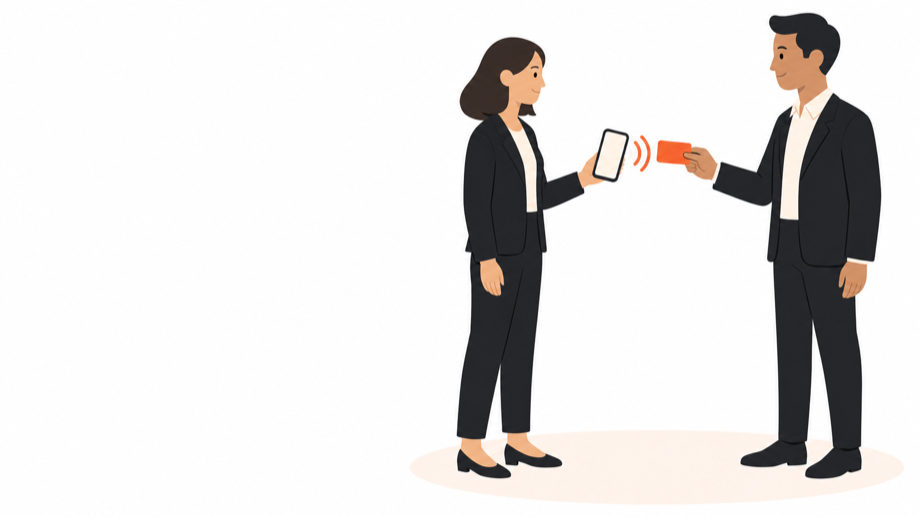
What happens when someone taps
At a client meeting or a trade show, the other person installs nothing. Press the button below and watch the whole flow on the phone to the right — from tapping the card to saving the contact.
Hold the card to a phone
The phone reads the NFC tag or scans the QR code, and a banner with the permanent URL appears at the top.
The card opens in three languages
Tapping the banner opens the card, with tabs for 中文, English and 日本語.
One tap to save the contact
Every card ships with a .vcf contact file generated from the same data as the page. It writes to the address book on both iPhone and Android.
Press “Tap the card” on the left to simulate holding a card to this phone.

- Company Demo Tech Co., Ltd.
- Tel 02-0000-0000
- Email [email protected]
Why the card never has to be reprinted
Most digital business cards print the card’s own address on the card. Change the content, the platform or the person, and the card is scrap. We keep the address printed on the card separate from where the card actually lives. That is the whole difference.
What is on the card
Company branding only, no personal name. The card is not tied to a person: collect it when someone leaves, and hand the same card to whoever takes the role next.
Where the card points
It points to an entry point that never changes — not to the card itself. New content, a new design, a new host: all of it happens behind that entry point, and the address you handed out does not change by a single character.
Where the content lives
We hold the content and all three translations. Staff changes, promotions, even a full redesign never touch the cards already in circulation.
Designed from the buyer’s side of the table
1. Print once, use for years
New platform, new design, new content — no reprint
What is printed on the card is a permanent entry point, not the card itself. We have swapped the back end three times behind it and never reprinted a card.
2. People leave. The card stays.
A resignation costs you a seat, not a card
Cards carry company branding, never a personal name. When someone leaves, take the card back and retire the address; whoever fills the seat picks up the same card.
3. You edit the Chinese. We guard the translations.
Chinese fields are yours to edit; English and Japanese are ours to maintain
That prevents the two usual disasters: someone editing a translation they cannot read, and a Chinese job title changing while the English and Japanese quietly stay wrong.
4. No accounts, no stored passwords
We do not run a membership system
There is nothing for your staff to remember: sign-in uses the Google account your company already has. No password database means no password breach.
How the seat model works
You are not buying N cards with N names on them. You are buying N seats that move between people. With cards sold outright, nine staff changes in three years means nine reprints. With seats, the physical card goes straight to the next person at no extra cost.



Note: while a seat is vacant, anyone tapping the old card or opening the old address sees a retired-card page. It never exposes a former employee’s details.
A typical digital card vs. Khansing
What sold-outright and per-seat look like over three years of staff turnover and upkeep.
| What you are comparing | Typical digital card | Khansing |
|---|---|---|
| Pricing | One card per person, sold outright | Per seat, annual or three-year |
| Someone leaves | Card is scrap | Seat is reclaimed, card is reused |
| Content edits | Usually billed separately | Included in the annual fee |
| Languages | Usually Chinese only | Chinese, English, Japanese |
| Changing platform | Reprint the cards | Cards stay as they are |
| Where your data sits | With the platform vendor | We hold the source and the data, and you can take both back |
Not mockups — cards that are live right now
Both screenshots are the real thing, taken from our demo client’s live cards at 390px phone width. Nothing retouched.
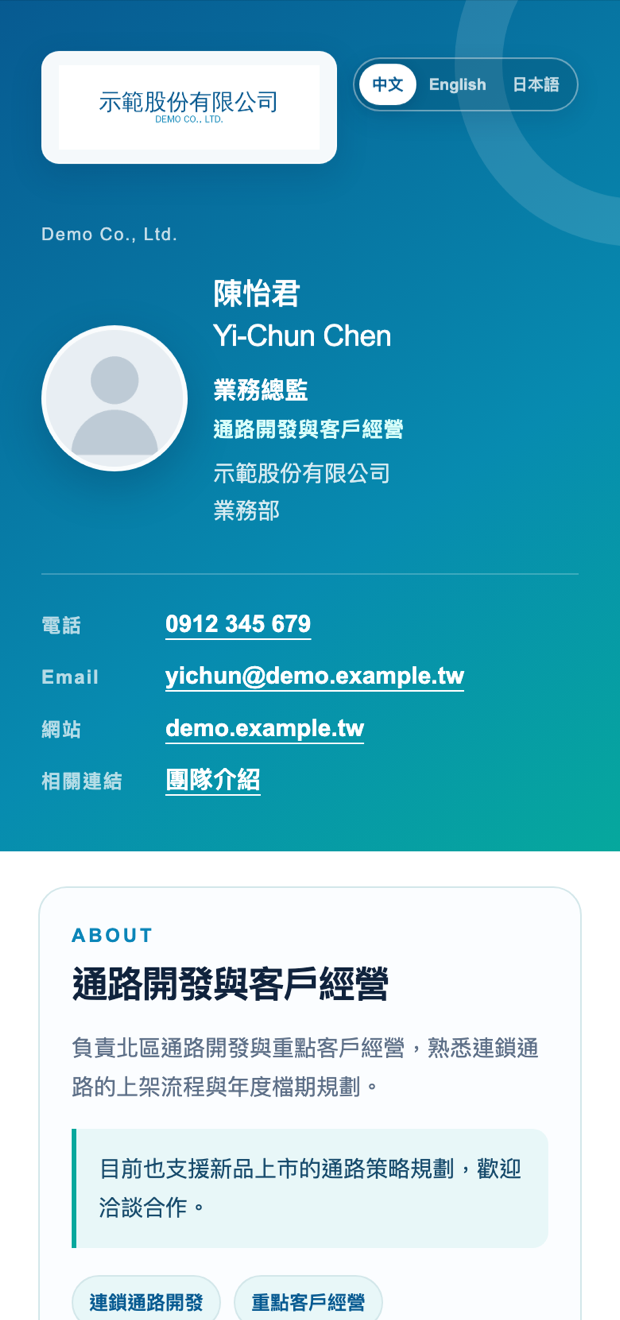
An active card
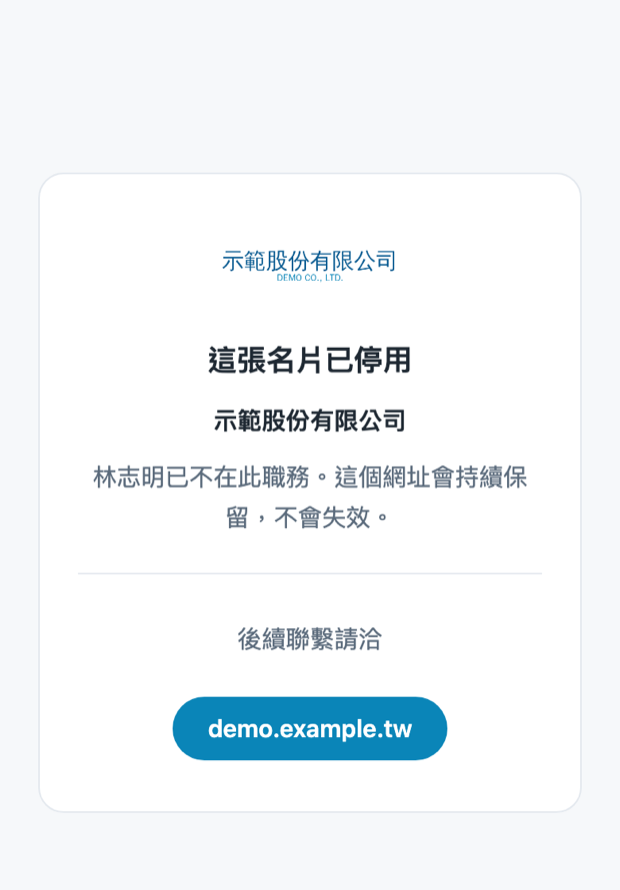
The same address once the seat is reclaimed
-
The one on the right is not a different address: it is the same address after the seat was reclaimed. Old cards never 404, and never lead to a former colleague’s details.
-
Language tabs sit in the top right: 中文, English and 日本語 switch in place on one page, not across three separate addresses.
-
“Where we met”: a visitor can note the occasion and a reminder. It goes into the contact file on their own phone and we keep no record of it.
-
Cards follow your brand, not ours: that blue is the demo client’s, not our orange. Every client gets their own palette.
How your team keeps the cards current
Nobody has to learn a new system, and nobody can accidentally break the layout or a translation.
-
A spreadsheet-style admin sheet: we give you a private online sheet as the back end, where your admin contact can see every seat at a glance.
-
Edit the Chinese yourself, live within one business day: edit the Chinese fields in the sheet, tell us when you are done, and it is live within one business day.
-
English and Japanese fields are locked: we maintain them and they are read-only on your side, so a translation cannot be broken or left out of sync.
-
Nothing to remember: no separate admin account to register — sign-in uses the Google account your company already has.
-
Private fields are explicitly controlled: messaging handles, personal photos and the like can be set to private outright, not just left blank.
Five steps to roll it out
From sizing the seat count to handing over the printed cards, we handle the build, the translations and the device testing.
Scope it
Agree the seat count and contract term, and collect whatever card artwork you already have.
Fill in the data
We send a private online sheet; your contact fills in everyone’s details in one pass.
We build it
All three languages, plus testing on real iPhone and Android handsets.
Cards delivered
Printed cards, the list of permanent addresses, and the admin sheet with instructions.
Ongoing upkeep
When people move or get promoted, you edit the Chinese and we handle review and translation.
Questions buyers usually ask
Not sure whether it fits your company?
Tell us roughly what you need and how many seats, and we will come back with a quote and a rollout assessment.